

Listen Up!
Details
Aberdour Cultural Association
About this item
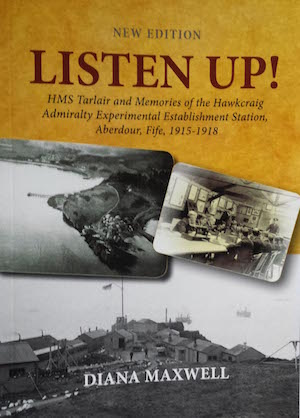
HMS Tarlair and Memories of the Hawkcraig Admiralty Experimental Establishment Station, Aberdour, Fife, 1915-1918
At the beginning of the First World War the German U-boat had become a major threat. HMS Lusitania was sunk by a U-boat in May 1915 with the loss of 1,195 lives, and one out of three merchant ships were lost. A German newspaper reported that their U-boats would destroy Britain.
Between 1915 and 1918 the Admiralty Experimental Establishment Station located at Hawkcraig Point in the Firth of Forth’s coastal village of Aberdour, Fife was the centre of a highly concentrated effort to defeat the German U-boats. It was the Navy’s main hydrophone research and training base. The naval establishment was named HMS Tarlair and the Hawkcraig experiments were under the command of Captain Cyril P Ryan, RN who lived at Hawkcraig Cottage (where the author now resides). The hydrophones (underwater microphone receivers) comprised a microphone enclosed between two diaphragms which vibrated when there was a pressure change caused by a sound wave. By rotating the hydrophone, the operator was able to listen for propeller and machinery noises that might indicate the presence of a submarine. These were the forerunner of today’s sophisticated sonar systems. The staff from HMS Tarlair were also responsible for fitting submarines with hydrophones and issuing special sets of hydrophones to the 1,500 drifters and motor launches in the Auxiliary patrol, which was the major part of the Navy’s anti-submarine force.
Little now remains of the experimental station; a few hut bases and relics of an old stone pier are all that can be seen. Originally there were up to sixteen huts of varying sizes, all constructed of wood. The research station had been set up at Granton, on the south of the Forth near Edinburgh, but moved in June 1915 to Hawkcraig Point on the north. The site was chosen because there was a deep-water channel protected by an anti-submarine boom.
The work carried out at HMS Tarlair is of local and national interest. During its short period of operation, major technological advances were achieved. It was one of the first instances of collaborative work between civil and military scientists and researchers. Investigation has uncovered a significant amount of archive and published material and the author has carried out her own original research to compile the information in this publication. This is not only the story of the development of technology, but also of the characters and personalities involved.
Contents
To Books & CDs